
Pharmaceutical contract manufacturing
The pharmaceutical industry is highly competitive, and companies need to balance product quality, manufacturing efficiency, regulatory requirements, costs, and speed to market. Building and operating an in-house manufacturing facility can require significant investment in infrastructure, equipment, skilled professionals, quality systems, maintenance, and regulatory compliance.
This is where pharmaceutical contract manufacturing provides a practical business solution.
Pharmaceutical contract manufacturing allows a pharma company or brand owner to partner with an experienced manufacturing organization to produce medicines and healthcare products according to agreed specifications, quality standards, packaging requirements, and production schedules. Instead of investing heavily in manufacturing infrastructure, companies can focus more on product development, branding, marketing, sales, distribution, and business expansion.
For startups, established pharmaceutical companies, healthcare brands, exporters, and businesses expanding their product portfolios, contract manufacturing can offer greater flexibility and operational efficiency.
In India, the pharmaceutical manufacturing ecosystem provides access to established manufacturing capabilities, skilled professionals, supply-chain networks, and cost-efficient production. This has made India an important destination for pharmaceutical manufacturing outsourcing.
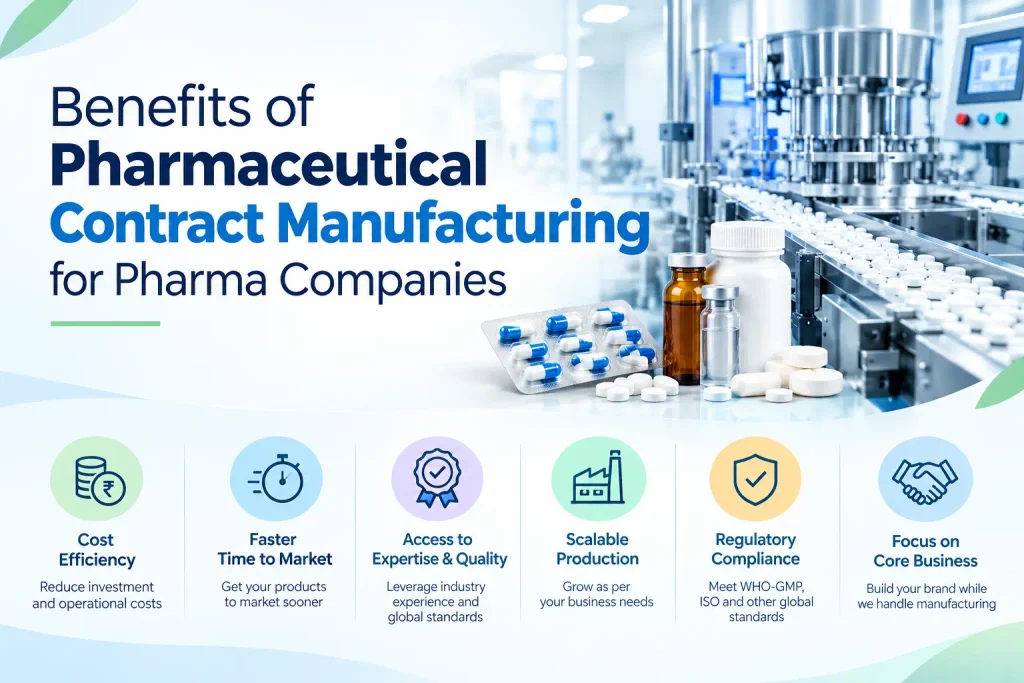
What Is Pharmaceutical Contract Manufacturing?
Pharmaceutical contract manufacturing is a business arrangement in which a pharmaceutical company outsources the production of medicines or pharmaceutical products to a specialized third-party manufacturing partner.
Depending on the agreement, a contract manufacturing partner may support activities such as:
- Product formulation and development
- Manufacturing and batch production
- Quality control and testing
- Packaging and labeling
- Documentation
- Batch-related quality records
- Regulatory support
- Product customization
- Private-label manufacturing
- Supply and dispatch coordination
The exact services depend on the capabilities of the manufacturer and the requirements of the client.
The basic concept is simple: instead of establishing and maintaining its own manufacturing facility, a company works with an experienced manufacturing partner to produce its pharmaceutical products.
Why Are Pharma Companies Choosing Contract Manufacturing?
Pharmaceutical manufacturing requires specialized infrastructure, trained personnel, quality systems, production equipment, documentation, and regulatory processes. Establishing all these capabilities internally can take considerable time and capital.
Contract manufacturing enables companies to use an existing manufacturing ecosystem while concentrating their internal resources on business-critical activities.
For example, a pharmaceutical brand can work with a manufacturing partner for production while concentrating on:
- Brand development
- Marketing
- Sales
- Distribution
- Customer relationships
- Product portfolio expansion
- Market research
This separation of responsibilities can help companies operate more efficiently.
10 Key Benefits of Pharmaceutical Contract Manufacturing
1. Lower Capital Investment
One of the major benefits of pharmaceutical contract manufacturing is the potential to reduce the capital investment required for manufacturing infrastructure.
Establishing an in-house pharmaceutical facility may require investment in production areas, equipment, utilities, laboratories, warehousing, quality systems, maintenance, and trained personnel.
By partnering with an established contract manufacturer, a company does not necessarily need to build the complete manufacturing infrastructure itself.
This allows businesses to allocate more resources toward product development, marketing, sales, distribution, and expansion.
Cost efficiency should always be evaluated based on the specific product, production volume, formulation, packaging, testing requirements, and commercial agreement rather than assuming a fixed percentage of savings.
2. Faster Product Launch
Speed is important in the pharmaceutical market.
Building a new manufacturing facility involves planning, infrastructure development, equipment installation, validation, staffing, quality systems, and regulatory requirements. An established manufacturing partner already has much of this operational infrastructure in place.
As a result, pharmaceutical companies may be able to move from product planning to commercial production more efficiently, subject to formulation approval, documentation, testing, regulatory requirements, and manufacturing schedules.
Faster manufacturing readiness can help businesses respond to market opportunities and introduce products without waiting to develop an entire facility from the ground up.
3. Access to Manufacturing Expertise
Experienced pharmaceutical manufacturers have specialized teams involved in production, quality control, quality assurance, documentation, formulation, packaging, and manufacturing operations.
Working with such a partner gives companies access to established manufacturing knowledge and processes without having to build the entire technical team internally.
Manufacturing expertise can be particularly valuable for startups and growing pharmaceutical companies that may have strong commercial capabilities but limited manufacturing infrastructure.
4. Better Focus on Core Business Activities
Manufacturing can be complex and resource-intensive.
When production is handled by a qualified manufacturing partner, the pharmaceutical company can dedicate more attention to its core commercial activities.
For example, the company can focus on:
- Building its pharmaceutical brand
- Expanding sales channels
- Developing distributor networks
- Improving customer relationships
- Marketing products
- Identifying new market opportunities
- Expanding its product portfolio
This can allow management teams to spend more time on growth rather than managing every aspect of manufacturing infrastructure.
5. Flexible Production Capacity
Demand for pharmaceutical products can change over time.
A new product may initially require relatively small production quantities and later experience significant demand growth. An established contract manufacturing relationship can provide greater flexibility to adjust production volumes, depending on available capacity and contractual arrangements.
This can be particularly useful for:
- New pharmaceutical brands
- Product launches
- Seasonal products
- Expanding companies
- Export-oriented businesses
- Companies testing new market opportunities
Production planning should still be based on realistic demand forecasts and the manufacturer’s available capacity.
6. Quality and Compliance Support
Quality is one of the most important considerations when selecting a pharmaceutical manufacturing partner.
A professional manufacturing organization should operate according to applicable quality systems, manufacturing procedures, documentation requirements, testing protocols, and regulatory standards.
Companies should carefully evaluate a manufacturer’s certifications, licenses, quality systems, manufacturing capabilities, audit history where available, and product-specific compliance requirements before entering into an agreement.
For pharmaceutical companies, working with a manufacturing partner that has appropriate quality systems can help establish greater confidence in manufacturing consistency and documentation.
7. Access to Specialized Manufacturing Capabilities
Different pharmaceutical products require different manufacturing technologies and production environments.
Depending on the facility, contract manufacturers may offer capabilities for various dosage forms such as:
- Tablets
- Capsules
- Syrups
- Dry syrups
- Powders
- Sachets
- Ointments
- Other pharmaceutical formulations
Before selecting a partner, companies should confirm that the manufacturer’s actual facility, equipment, licenses, quality systems, and technical capabilities match the specific product requirements.
This can be more efficient than investing in specialized infrastructure for every new dosage form.
8. Easier Product Portfolio Expansion
Pharmaceutical companies often want to introduce new products to strengthen their portfolio.
Building dedicated manufacturing infrastructure for every new formulation may not be practical.
Contract manufacturing can provide access to an established production ecosystem, making it easier for companies to evaluate and expand their product range.
For example, a company producing a particular range of pharmaceutical products may explore additional tablets, capsules, syrups, or other suitable formulations through manufacturing partnerships.
This can support portfolio diversification while allowing the company to concentrate on commercial development.
9. Support for Private Label and Customized Products
Many healthcare and pharmaceutical brands want products manufactured under their own brand names and packaging.
Depending on the manufacturer’s capabilities and applicable regulations, contract manufacturing can support customized product requirements, including formulation specifications, packaging formats, labeling, and branding.
This model can be useful for:
- Pharmaceutical startups
- Healthcare brands
- Distributors
- Export businesses
- Product marketers
- Established pharma companies
The exact customization available depends on the product, regulatory requirements, manufacturing capabilities, and agreement between the client and manufacturer.
10. Improved Scalability for Growing Businesses
A pharmaceutical company may start with a limited product range and gradually expand into additional markets.
Contract manufacturing can provide a scalable manufacturing model because companies can work with established production facilities instead of immediately investing in their own manufacturing infrastructure.
As business requirements change, companies can evaluate additional products, production quantities, packaging formats, and markets with their manufacturing partner.
This makes contract manufacturing particularly relevant for businesses that want to grow without making manufacturing infrastructure their primary investment.
Pharmaceutical Contract Manufacturing vs In-House Manufacturing
Both models have advantages, and the right choice depends on the company’s strategy.
| Factor | Contract Manufacturing | In-House Manufacturing |
|---|---|---|
| Initial infrastructure investment | Generally lower | Generally higher |
| Facility management | Handled by manufacturing partner | Managed internally |
| Manufacturing expertise | Access through partner | Build internal team |
| Production flexibility | Depends on partner capacity | Controlled internally |
| Quality management | Partner + client oversight | Internal system |
| Operational responsibility | Shared according to agreement | Primarily internal |
| Expansion | Can leverage partner capabilities | Requires additional investment |
| Focus | Greater focus on commercial growth | Greater manufacturing control |
The decision should be based on product requirements, expected volumes, regulatory obligations, quality expectations, long-term strategy, and total cost of ownership.
How to Choose the Right Pharmaceutical Contract Manufacturer
Choosing the right manufacturing partner is one of the most important steps in a contract manufacturing strategy.
Before signing an agreement, pharmaceutical companies should evaluate:
Manufacturing Capabilities
Check whether the facility can manufacture the required dosage form and production volume.
Quality Systems
Review applicable certifications, quality procedures, testing capabilities, documentation systems, and compliance requirements.
Product Experience
Consider whether the manufacturer has relevant experience with the type of pharmaceutical products you plan to manufacture.
Production Capacity
Ensure the manufacturer can support current requirements as well as potential future growth.
Packaging Capabilities
Check available packaging formats and whether customized packaging can be supported.
Documentation
Clear documentation is essential for pharmaceutical manufacturing. Discuss specifications, batch records, testing documentation, quality agreements, and other applicable records.
Communication
Reliable communication helps reduce misunderstandings regarding product specifications, timelines, packaging, and production schedules.
Delivery and Supply Chain
Evaluate manufacturing lead times, logistics support, warehousing arrangements, and dispatch processes.
Why Pharmaceutical Contract Manufacturing in India?
India has developed a large pharmaceutical manufacturing ecosystem supported by manufacturing expertise, skilled professionals, established supply chains, and cost-efficient production capabilities. Industry research also identifies lower manufacturing costs and established manufacturing infrastructure as important factors supporting India’s contract manufacturing sector.
For international and domestic businesses, India can therefore be considered as a manufacturing base when the selected facility meets the product’s quality, regulatory, technical, and commercial requirements.
However, companies should not select a manufacturer based only on price. Quality systems, documentation, regulatory compliance, manufacturing capability, consistency, communication, and delivery performance should also be evaluated.
Why Choose Krone Biocare for Pharmaceutical Manufacturing?
Krone Biocare provides pharmaceutical manufacturing solutions for businesses looking to develop and manufacture pharmaceutical products through an experienced manufacturing partner.
The company focuses on supporting clients through manufacturing, product development, packaging, quality processes, and related requirements based on the project.
For pharmaceutical companies, startups, healthcare brands, distributors, marketers, and businesses exploring new product opportunities, a manufacturing partnership can provide a structured approach to bringing products to market.
When evaluating Krone Biocare or any pharmaceutical manufacturing partner, businesses should discuss their product requirements, formulation, dosage form, packaging, expected quantities, regulatory requirements, quality expectations, and delivery timelines before beginning production.
Frequently Asked Questions
What is pharmaceutical contract manufacturing?
Pharmaceutical contract manufacturing is a model in which a pharmaceutical company outsources the manufacturing of its products to a specialized third-party manufacturing partner.
What are the main benefits of pharmaceutical contract manufacturing?
The main benefits can include lower infrastructure investment, access to manufacturing expertise, faster production readiness, flexible capacity, quality-system support, and the ability to focus more on sales and business development.
Is pharmaceutical contract manufacturing suitable for startups?
Yes. Contract manufacturing can be particularly useful for startups because it can reduce the need to establish a complete manufacturing infrastructure at the beginning of the business.
Is pharmaceutical contract manufacturing the same as third-party manufacturing?
The terms are often used interchangeably in the Indian pharmaceutical industry, although the exact scope of services can vary between agreements and manufacturers.
Can pharmaceutical products be manufactured under a company’s own brand?
Depending on the product, applicable regulations, and manufacturing agreement, contract manufacturers can support private-label or branded manufacturing requirements.
How do I select a pharmaceutical contract manufacturing company?
Evaluate manufacturing capabilities, quality systems, relevant certifications and licenses, product experience, production capacity, documentation, packaging capabilities, communication, delivery performance, and commercial terms.
Conclusion
Pharmaceutical contract manufacturing has become an important business model for companies that want to access manufacturing capabilities without necessarily building and operating their own complete production infrastructure.
The potential benefits include lower capital requirements, faster production readiness, access to technical expertise, flexible manufacturing capacity, quality-system support, portfolio expansion, and greater focus on core commercial activities.
However, successful outsourcing depends on choosing the right manufacturing partner. Pharmaceutical companies should evaluate quality, compliance, manufacturing capabilities, documentation, capacity, communication, packaging, and supply-chain requirements before entering into a manufacturing relationship.
For companies planning to launch, expand, or diversify pharmaceutical products, working with the right contract manufacturing partner can provide a practical path toward efficient and scalable pharmaceutical production.

Looking for a pharmaceutical manufacturing partner in India? Explore Krone Biocare‘s pharmaceutical manufacturing capabilities and discuss your product requirements with our team.
A WHO-GMP Certified Manufacturing Unit
Pharmaceutical contract manufacturing, Pharmaceutical contract manufacturing, Pharmaceutical contract manufacturing, Pharmaceutical contract manufacturing, Pharmaceutical contract manufacturing, Pharmaceutical contract manufacturing