
10 Things to Check Before Selecting a Pharmaceutical Manufacturing Company
Choosing the right pharmaceutical manufacturing company is one of the most important decisions for any pharmaceutical business. Whether you are launching a new pharma brand, expanding your existing product portfolio, or looking for a reliable third-party manufacturing partner, selecting the right manufacturer can directly influence your product quality, business reputation and long-term growth.
The pharmaceutical industry operates under strict quality, safety and regulatory requirements. Therefore, working with a manufacturer is not simply about finding a company that offers affordable production. It is about identifying a manufacturing partner that understands pharmaceutical standards, maintains consistent quality, follows applicable regulations and delivers products within agreed timelines.
Today, many pharmaceutical companies in India prefer third-party manufacturing because it allows them to focus on marketing, distribution, brand development and customer relationships without investing heavily in their own manufacturing infrastructure.
However, not every pharmaceutical manufacturer offers the same level of expertise, production capabilities or quality assurance.
Before signing an agreement, pharma entrepreneurs and business owners should carefully evaluate the manufacturer’s certifications, manufacturing facilities, product range, quality control systems, pricing structure and delivery commitments.
In this article, we will explore the 10 important things to check before selecting a pharmaceutical manufacturing company so you can make a more informed business decision.
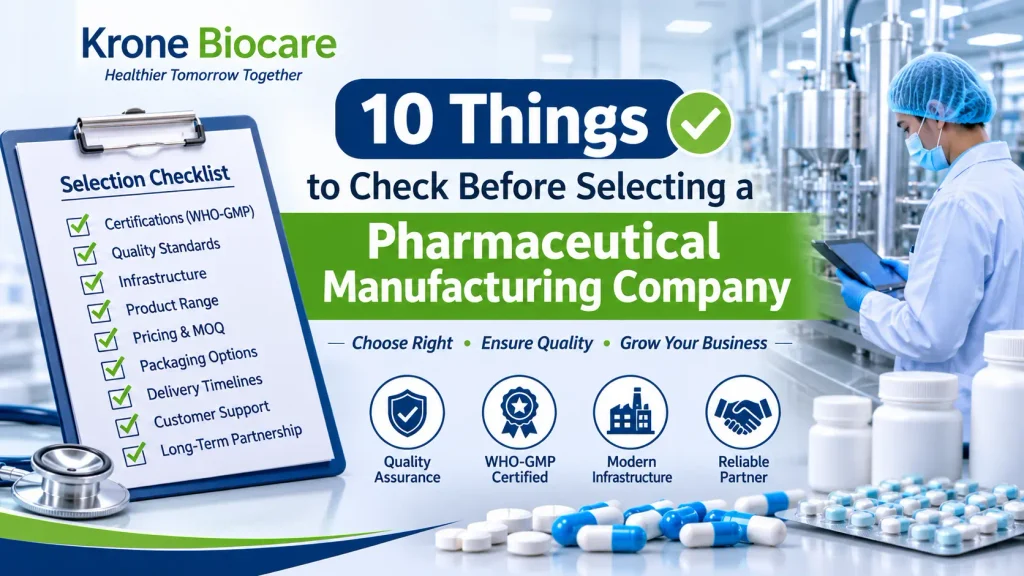
1. Check Manufacturing Certifications and Regulatory Compliance
The first thing to verify when selecting a pharmaceutical manufacturing company is its manufacturing licences, certifications and regulatory compliance.
Pharmaceutical products must be manufactured according to applicable quality and safety requirements. A manufacturer should have the appropriate licences and approvals for the specific product categories it manufactures.
Important credentials and standards to evaluate include:
- WHO-GMP certification, where applicable.
- Relevant manufacturing licences.
- Applicable Schedule M compliance.
- ISO certification, where relevant.
- Regulatory documentation for the products being manufactured.
- Compliance with applicable drug manufacturing regulations.
WHO-GMP stands for World Health Organization – Good Manufacturing Practices. These guidelines provide a framework for maintaining quality throughout pharmaceutical manufacturing processes.
A compliant manufacturing environment helps ensure that products are manufactured, tested, packed and stored under controlled conditions.
Before finalizing a manufacturer, request copies of relevant licences and certificates. Verify their validity, scope and applicability to the manufacturing facility and product category.
Why does this matter?
Working with a properly licensed and compliant manufacturer helps reduce regulatory risks and supports confidence in product quality and manufacturing standards.
2. Evaluate the Manufacturing Infrastructure and Facilities
A pharmaceutical manufacturer’s infrastructure plays an important role in its production capabilities and operational efficiency.
Before selecting a manufacturing partner, understand whether its facilities are suitable for the products you intend to manufacture.
A professional pharmaceutical manufacturing company should have appropriate arrangements for:
- Raw material storage.
- Manufacturing and processing areas.
- Quality control laboratories.
- Packaging and labelling sections.
- Finished goods storage.
- Hygiene and sanitation.
- Environmental and process monitoring.
- Equipment maintenance and calibration.
Manufacturing infrastructure should also be suitable for the specific dosage forms being produced.
For example, tablet manufacturing requires different equipment and production arrangements compared with liquid syrups, capsules, injections or ointments.
If possible, request a facility visit or a virtual manufacturing tour. This can help you understand the manufacturer’s operational capabilities and quality systems.
Business tip: Do not select a manufacturer only because it has an attractive website or product catalogue. Evaluate its actual production capabilities and documentation.
3. Review Product Range and Manufacturing Capabilities
The third important factor is the manufacturer’s product portfolio and production capabilities.
Every pharmaceutical business has different product requirements. Some companies focus on tablets and capsules, while others require syrups, dry syrups, injections, ointments or specialized formulations.
Before selecting a pharmaceutical manufacturing company, check whether it can manufacture the products required for your business.
Common pharmaceutical product categories include:
- Tablets and dispersible tablets.
- Hard gelatin and soft gelatin capsules.
- Syrups and suspensions.
- Dry syrups.
- Injections.
- Ointments and creams.
- Pharmaceutical powders.
- Other specialized dosage forms, depending on the facility’s approvals.
A manufacturer with a suitable product portfolio can help you expand your brand without repeatedly searching for new manufacturing partners.
You should also ask about its experience with different formulations, packaging formats and production volumes.
For example, if you are planning to introduce a range of pharmaceutical tablets, capsules and syrups, choosing a partner with capabilities across these categories can simplify coordination.
What should you ask the manufacturer?
- Which pharmaceutical dosage forms do you manufacture?
- Can you develop customized formulations?
- Do you offer private labelling?
- What are your minimum order quantities?
- Can you support future product expansion?
Selecting a manufacturer with suitable production capabilities can make your business expansion more manageable.
4. Examine Quality Control and Quality Assurance Systems
Quality should never be compromised when choosing a pharmaceutical manufacturing company.
Pharmaceutical products are directly related to human health. Therefore, manufacturers must follow appropriate quality control and quality assurance procedures throughout the production process.
Quality control involves testing materials and products to verify that they meet defined specifications. Quality assurance focuses on the systems and procedures used to maintain consistent manufacturing quality.
Important quality-related processes include:
- Raw material testing.
- In-process quality checks.
- Finished product testing.
- Packaging material inspection.
- Batch documentation.
- Stability studies, where applicable.
- Proper storage conditions.
- Batch traceability and record maintenance.
A reliable manufacturer should have documented quality procedures and suitable testing arrangements.
Ask whether the company provides relevant quality documents, such as Certificates of Analysis (COA), batch manufacturing records and finished product test reports, as applicable.
You should also understand how the manufacturer handles product complaints, deviations, out-of-specification results and product recalls.
Why is quality control important?
Consistent quality management helps reduce manufacturing errors, supports regulatory compliance and protects your pharmaceutical brand’s reputation.
Remember that a low manufacturing price is not a good deal if the manufacturer cannot demonstrate appropriate quality systems.
5. Check Experience and Industry Reputation
Experience is another important consideration when selecting a pharmaceutical manufacturing company.
A manufacturer with relevant industry experience may have a better understanding of production planning, formulation requirements, packaging challenges and regulatory expectations.
However, experience should not be judged only by the number of years a company has been operating.
You should evaluate its actual manufacturing experience in your required product category.
Consider checking:
- Experience in pharmaceutical manufacturing.
- Expertise in relevant dosage forms.
- Manufacturing infrastructure and technical team.
- Client service capabilities.
- Product quality documentation.
- Business references, where available.
- Consistency in fulfilling manufacturing commitments.
You can also review the company’s official website, business profile and available client feedback.
Ask for examples of its manufacturing capabilities and product categories rather than relying entirely on promotional claims.
Pro tip: A manufacturer that communicates clearly, shares relevant documentation and explains its production process transparently is generally easier to evaluate as a potential business partner.
6. Understand Minimum Order Quantity and Pricing Structure
Pricing is an important factor for every pharmaceutical business, particularly startups and companies entering new product categories.
However, selecting a pharmaceutical manufacturing company based only on the lowest quotation can create problems later.
Different manufacturers may offer different pricing depending on formulation, raw material costs, packaging specifications, order quantity and testing requirements.
Before placing an order, request a detailed quotation.
Understand the following pricing components:
- Manufacturing cost per unit.
- Raw material cost.
- Packaging material cost.
- Printing and labelling charges.
- Testing and documentation charges, where applicable.
- Transportation and delivery costs.
- Applicable taxes.
- Minimum order quantity (MOQ).
Why is MOQ important?
Minimum order quantity refers to the minimum number of units a manufacturer accepts for a particular product order.
For example, a startup may want to introduce a new pharmaceutical product in a limited quantity to understand market demand. In such a situation, a suitable MOQ can help manage initial investment.
Ask the manufacturer whether its MOQ varies according to product type, formulation and packaging requirements.
Compare quotations carefully
Do not compare two manufacturers only by their final quoted price.
Check whether both quotations include the same formulation, packaging quality, product specifications, documentation and testing requirements.
A transparent quotation helps you calculate your actual product cost and estimate your profit margins more accurately.
7. Evaluate Packaging, Labelling and Private Label Services
Packaging is not just about the appearance of a pharmaceutical product. It also plays an important role in product protection, identification, storage and regulatory compliance.
If you are building your own pharmaceutical brand, check whether the manufacturer provides suitable packaging and private-label manufacturing services.
Common pharmaceutical packaging formats include:
- Blister packaging.
- Strip packaging.
- HDPE bottles.
- Glass bottles.
- Plastic bottles.
- Cartons and mono cartons.
- Labels and printed packaging materials.
- Sachets and other approved formats.
The packaging must be suitable for the product’s dosage form and storage requirements.
What is private-label pharmaceutical manufacturing?
Private-label manufacturing allows a business to market products under its own brand name while an authorized manufacturing partner undertakes the manufacturing process.
This model can be useful for pharma startups, distributors, marketing companies and established pharmaceutical businesses.
Before finalizing private-label services, discuss:
- Brand name and product artwork.
- Packaging material specifications.
- Label and carton requirements.
- Regulatory labelling requirements.
- Batch number and expiry details.
- Artwork approval process.
- Packaging timelines.
Also confirm that all proposed brand names, claims and product labels meet applicable regulatory requirements.
A manufacturer with suitable packaging coordination can make the product launch process more organized and efficient.
8. Verify Delivery Timelines and Supply Chain Management
Timely delivery is essential for pharmaceutical businesses.
Delays in manufacturing or product dispatch can affect distributor relationships, marketing campaigns, stock availability and customer commitments.
Therefore, evaluate the manufacturer’s production planning and supply chain management before entering into a manufacturing agreement.
Ask the manufacturer about:
- Expected production lead time.
- Availability of raw materials.
- Packaging material procurement.
- Production scheduling.
- Quality testing timelines.
- Finished goods storage.
- Dispatch arrangements.
- Order tracking and communication.
Why is supply chain reliability important?
Pharmaceutical businesses often work with distributors, stockists, retailers and healthcare institutions. These business relationships depend on consistent product availability.
A manufacturer should provide realistic delivery commitments rather than promising unrealistic timelines to secure an order.
It is also useful to understand how the company manages unexpected delays, raw material shortages and changes in production schedules.
Discuss delivery terms in advance and include mutually agreed timelines in the manufacturing arrangement.
For growing pharmaceutical brands, reliable supply chain coordination can support better inventory planning and business continuity.
9. Check Communication, Documentation and Customer Support
Good communication is often overlooked when selecting a pharmaceutical manufacturing company.
However, manufacturing partnerships involve multiple activities, including product selection, quotation approval, artwork development, documentation, production scheduling, quality checks and dispatch.
If communication is poor, even a technically capable manufacturer can become difficult to work with.
Before finalizing a partner, evaluate its responsiveness and customer support.
Check whether the company provides:
- A dedicated business contact.
- Timely quotation updates.
- Clear product specifications.
- Manufacturing status updates.
- Documentation support.
- Packaging and artwork coordination.
- Dispatch information.
- Assistance with product-related queries.
Important documents to discuss
Depending on the product and regulatory requirements, you may need:
- Manufacturing licence details.
- Relevant certification copies.
- Product specifications.
- Certificate of Analysis.
- Batch-related documentation.
- Product test reports.
- Stability-related documentation, where applicable.
- Manufacturing and supply agreement.
Also discuss confidentiality, ownership of customized formulations, artwork usage, product responsibilities and complaint-handling procedures.
A clearly defined agreement helps both parties understand their obligations.
For a long-term pharmaceutical manufacturing relationship, professional communication is just as important as production capacity.
10. Evaluate Future Business Growth and Long-Term Partnership Potential
The final point is to consider whether the pharmaceutical manufacturing company can support your future business requirements.
Your initial requirement may be limited to a few products, but your business portfolio could expand over time.
You may eventually want to introduce additional tablets, capsules, syrups, dry syrups or other pharmaceutical formulations.
Therefore, select a manufacturer that has suitable capabilities and a realistic plan for supporting your future requirements.
Consider these factors:
- Ability to manufacture additional product categories.
- Capacity to handle increased order quantities.
- Customized formulation support.
- Consistent quality management.
- Packaging flexibility.
- Long-term supply planning.
- Professional business coordination.
- Regulatory and documentation support.
Think beyond your first order
A successful pharmaceutical brand requires consistent product availability, quality and business coordination.
Changing manufacturers frequently can create additional administrative work, documentation challenges and supply chain complications.
A reliable manufacturing partner can help you build a more stable business model.
Before signing a long-term agreement, discuss your expected product requirements, future expansion plans and commercial expectations.
The right manufacturing relationship should benefit both businesses over the long term.
How to Choose the Right Pharmaceutical Manufacturing Partner in India?
India has become an important destination for pharmaceutical manufacturing because of its established pharmaceutical industry, manufacturing infrastructure and availability of technical expertise.
However, choosing the right manufacturing partner requires proper research.
Before finalizing a company, prepare a checklist covering its manufacturing capabilities, quality standards, documentation, commercial terms and delivery commitments.
You should also compare at least two or three manufacturers before making your final decision.
A good pharmaceutical manufacturing partner should offer more than production services. It should understand your business requirements and help you maintain consistent product quality while supporting your growth.
Why Choose Krone Biocare for Pharmaceutical Third Party Manufacturing?
Krone Biocare is a pharmaceutical, nutraceutical and Ayurvedic manufacturing company based in the Mohali, Punjab region.
The company focuses on third-party manufacturing and private-label solutions for businesses looking to develop and expand their healthcare product portfolios.
For pharmaceutical businesses, choosing a manufacturing partner with suitable production capabilities, quality-focused processes and professional coordination is important.
Our pharmaceutical manufacturing capabilities
- Tablets Manufacturing: Pharmaceutical tablet manufacturing solutions for different product requirements.
- Capsules Manufacturing: Manufacturing support for suitable pharmaceutical capsule formulations.
- Syrup Manufacturing: Liquid pharmaceutical product manufacturing and packaging.
- Dry Syrup Manufacturing: Manufacturing solutions for dry syrup formulations.
- Ointment Manufacturing: Topical pharmaceutical product manufacturing, subject to facility capabilities and approvals.
- Private Label Manufacturing: Product branding, packaging and manufacturing coordination.
Why consider Krone Biocare?
- Pharmaceutical third-party manufacturing solutions.
- Multiple product category options.
- Private-label manufacturing support.
- Packaging and product development coordination.
- Business-focused manufacturing services.
- Manufacturing facility in Mohali, Punjab.
Whether you are an established pharmaceutical company, a distributor or a startup planning to introduce your own pharma brand, selecting the right manufacturing partner is an important step towards sustainable business growth.
Explore our website: Krone Biocare – Official Website
Enquire about manufacturing: Contact Krone Biocare
Frequently Asked Questions (FAQs)
1. What should I check before selecting a pharmaceutical manufacturing company?
Check manufacturing licences, applicable certifications, production facilities, quality control systems, product range, pricing, minimum order quantity, packaging capabilities and delivery commitments.
2. What is pharmaceutical third-party manufacturing?
Pharmaceutical third-party manufacturing is a business arrangement in which a pharmaceutical company outsources product manufacturing to another authorized manufacturing company. The products may be marketed under the brand owner’s name, subject to applicable regulatory requirements and agreements.
3. Why is WHO-GMP certification important in pharmaceutical manufacturing?
WHO-GMP guidelines provide standards and principles for maintaining quality, consistency and safety in pharmaceutical manufacturing. Businesses should verify the manufacturer’s applicable certifications and regulatory compliance before placing an order.
4. What pharmaceutical products can be manufactured through third-party manufacturing?
Depending on the manufacturer’s licences and facilities, pharmaceutical products may include tablets, capsules, syrups, dry syrups, injections, ointments and other dosage forms.
5. What is the minimum order quantity for pharmaceutical third-party manufacturing?
MOQ depends on the product formulation, dosage form, packaging specifications, raw materials and manufacturer’s production requirements. It is advisable to request a product-specific quotation.
6. Can startups launch their own pharmaceutical brand through third-party manufacturing?
Yes. Startups can explore third-party manufacturing to launch their own pharmaceutical brands without establishing an independent manufacturing facility. They must comply with applicable licensing, labelling, marketing and regulatory requirements.
7. What documents should I request from a pharmaceutical manufacturer?
You should request relevant manufacturing licence details, applicable certification documents, product specifications, quality test reports and other product-specific documentation required for your business and regulatory compliance.
8. What is the difference between contract manufacturing and third-party manufacturing?
Both involve outsourcing manufacturing activities to another company. The specific commercial arrangement, responsibilities, regulatory obligations and ownership rights depend on the agreement between the parties.
9. How can I verify the quality of a pharmaceutical manufacturing company?
Review its manufacturing licences, facility standards, quality assurance procedures, testing arrangements, batch documentation and relevant regulatory records. A facility audit may also be useful.
10. Is pharmaceutical third-party manufacturing suitable for established pharma companies?
Yes. Established pharmaceutical companies may use third-party manufacturing to expand their product portfolios, manage production requirements and reduce the need for additional manufacturing infrastructure.
Conclusion
Selecting the right pharmaceutical manufacturing company requires careful evaluation of several important factors. From manufacturing certifications and infrastructure to product quality, pricing, packaging and delivery, every aspect contributes to a successful manufacturing partnership.
Do not make your decision based only on price. Focus on manufacturing capabilities, quality systems, regulatory compliance and long-term business support.
For pharmaceutical startups, distributors and established pharma companies, the right third-party manufacturing partner can help simplify operations and create opportunities for business expansion.
Looking for a pharmaceutical third-party manufacturing partner in India?
Connect with Krone Biocare to discuss your pharmaceutical product requirements and explore suitable manufacturing solutions.
Website: https://www.kronebiocare.com/
Email: info@kronecare.com
Contact: +91 9988188811
For additional information about pharmaceutical quality standards and government health regulations, readers can visit the official Home | Ministry of Health & Family Welfare Ministry of Health and Family Welfare, Government of India website.