
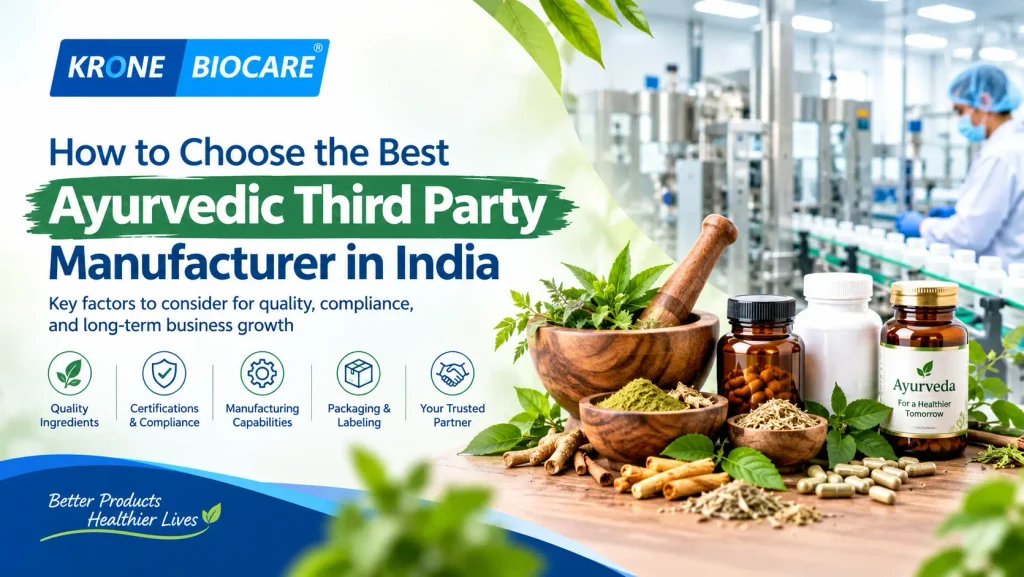
How to Choose the Best Ayurvedic Third Party Manufacturer in India
The demand for Ayurvedic and herbal healthcare products is growing rapidly in India as consumers increasingly look for wellness solutions based on traditional knowledge and modern quality standards. For businesses planning to launch Ayurvedic products, choosing the right manufacturing partner is one of the most important decisions.
A reliable Ayurvedic third party manufacturer in India can help brands with product formulation, raw material sourcing, manufacturing, quality testing, packaging, labeling, documentation, and product delivery. The right partner allows a business to focus on branding, marketing, distribution, and customer growth without investing heavily in its own manufacturing facility.
However, not every manufacturer offers the same level of quality, flexibility, regulatory support, or manufacturing capabilities. Before finalizing a manufacturing partner, Ayurvedic brands should carefully evaluate several factors.
In this guide, we explain how to choose the best Ayurvedic third party manufacturer in India, what questions to ask, which certifications to verify, and what factors can help you build a reliable Ayurvedic product brand.
What Is Ayurvedic Third Party Manufacturing?
Ayurvedic third party manufacturing is a business arrangement in which an Ayurvedic manufacturer produces products on behalf of another company or brand.
The brand owner generally provides the product requirements, specifications, or formulation preferences, while the manufacturing company handles production and related processes.
Depending on the manufacturer, services may include:
- Ayurvedic product formulation
- Product development
- Raw material sourcing
- Manufacturing
- Quality testing
- Packaging
- Labeling
- Batch production
- Documentation
- Product dispatch
- Regulatory support
This model is particularly useful for startups, distributors, healthcare companies, entrepreneurs, and established brands that want to introduce Ayurvedic products without setting up their own manufacturing plant.
Why Choosing the Right Ayurvedic Manufacturer Matters
Your manufacturing partner directly influences the quality, consistency, scalability, and reputation of your products.
A manufacturer may offer competitive pricing, but low cost alone should never be the deciding factor. A product that fails to meet quality expectations can result in customer complaints, regulatory problems, delayed deliveries, and damage to your brand reputation.
A reliable manufacturing partner can provide:
Consistent Product Quality
Quality consistency is essential when producing Ayurvedic products at commercial scale. Every batch should follow defined manufacturing and quality-control procedures.
Better Product Development
An experienced manufacturer can help transform an idea into a commercially viable product through formulation development, dosage-form selection, and packaging support.
Reliable Supply
A good manufacturing partner should have sufficient production capacity and an organized supply chain to support regular orders.
Regulatory Support
Ayurvedic products need to comply with applicable regulations and labeling requirements. An experienced manufacturer can help brands understand the documentation and compliance process.
Business Scalability
As your brand grows, your manufacturing requirements may increase. Choosing a manufacturer capable of handling larger volumes can make expansion easier.
10 Factors to Consider When Choosing an Ayurvedic Third Party Manufacturer in India
Choosing an Ayurvedic manufacturing partner requires more than comparing quotations. Consider the following factors before making your decision.
1. Check Manufacturing Experience
The first factor to evaluate is the manufacturer’s experience.
An established Ayurvedic third party manufacturing company in India should understand Ayurvedic formulations, manufacturing processes, raw materials, dosage forms, packaging requirements, and quality-control procedures.
Ask potential manufacturers:
- How long have they been manufacturing Ayurvedic products?
- What types of products do they manufacture?
- Do they work with startups and established brands?
- What dosage forms are available?
- Can they handle customized formulations?
- What is their production capacity?
Experience can be particularly valuable when you are launching a new product and need assistance with formulation, packaging, and manufacturing decisions.
2. Verify Manufacturing Certifications and Compliance
Certifications and regulatory compliance are among the most important factors when selecting a manufacturer.
Before placing an order, ask the manufacturer to provide relevant certification and licensing information applicable to the products being manufactured.
Depending on the facility and product category, you may encounter certifications or standards such as:
- GMP-related compliance
- ISO certifications
- Ayurvedic manufacturing licenses
- Quality-management systems
- Laboratory and testing standards
- Applicable regulatory approvals
Do not simply rely on certification logos displayed on a website. Ask for relevant documentation and verify that the certifications apply to the manufacturing facility and product category you are considering.
A compliant manufacturing environment demonstrates that the manufacturer takes standardized production and quality procedures seriously.
3. Evaluate the Manufacturing Facility
If possible, visit the manufacturing facility before finalizing a long-term partnership.
A facility visit can help you understand how the manufacturer manages:
- Raw materials
- Production areas
- Storage
- Packaging
- Quality control
- Finished products
- Hygiene
- Documentation
- Batch processing
A professional manufacturing facility should have organized processes and clearly defined areas for different manufacturing activities.
If a physical visit is not possible, request photographs, videos, facility information, certifications, and manufacturing documentation.
4. Review Product Manufacturing Capabilities
Every Ayurvedic manufacturer does not necessarily manufacture every type of product.
Before selecting a partner, confirm whether the company can manufacture the dosage form you require.
Potential Ayurvedic product formats may include:
- Tablets
- Capsules
- Syrups
- Powders
- Herbal formulations
- Oils
- Churnas
- Proprietary Ayurvedic products
- Other customized formulations
Your requirements may also include specific packaging formats such as bottles, jars, cartons, strips, sachets, or customized boxes.
Choose a manufacturer whose capabilities match your current requirements and future product plans.
5. Look for Custom Formulation and Product Development
If you are building a unique Ayurvedic brand, custom formulation support can be a major advantage.
Some brands want to manufacture an existing formulation, while others want to develop a differentiated product.
Ask whether the manufacturer provides:
- Custom formulation development
- Ingredient selection
- Dosage-form development
- Product customization
- Flavour development where applicable
- Packaging recommendations
- Product documentation
A manufacturer with product-development capabilities can help reduce the complexity of launching a new Ayurvedic product.
6. Assess Raw Material Quality
Raw materials have a direct impact on the quality and consistency of Ayurvedic products.
Ask the manufacturer about its raw material procurement and quality-control process.
Important questions include:
- Where are raw materials sourced?
- Are suppliers evaluated?
- Are incoming materials tested?
- How are raw materials stored?
- Are batch records maintained?
- How is material traceability managed?
Quality-conscious manufacturers should have defined procedures for receiving, identifying, storing, testing, and releasing raw materials.
The goal is not simply to obtain inexpensive ingredients but to maintain consistent quality and product specifications.
7. Understand Quality Testing Procedures
Quality testing should be an integral part of Ayurvedic manufacturing.
Ask the manufacturer how it manages quality testing for raw materials, in-process materials, and finished products.
Depending on the product, testing may involve parameters relevant to identity, purity, strength, microbiological quality, physical characteristics, and other applicable specifications.
You should also understand what documentation is provided with finished batches.
A strong quality-control system helps identify problems before products reach the market.
8. Compare Minimum Order Quantities
Minimum Order Quantity, or MOQ, is especially important for startups and new brands.
Some manufacturers may require large production quantities, while others offer more flexible manufacturing options.
Before selecting a company, ask:
- What is the minimum order quantity?
- Does MOQ vary by product?
- Does customized packaging affect MOQ?
- Can the quantity be increased later?
- What are the price differences at different volumes?
Do not automatically select the manufacturer with the lowest MOQ. Consider MOQ together with quality, pricing, packaging, production capacity, and service.
A balanced manufacturing arrangement should support your current business size while allowing you to scale.
9. Evaluate Packaging and Labeling Support
Packaging is an important part of Ayurvedic product branding.
A manufacturer that provides packaging and labeling support can simplify the process for brand owners.
Ask whether the manufacturer can assist with:
- Bottle and container selection
- Carton packaging
- Labels
- Product artwork coordination
- Batch information
- Manufacturing details
- Packaging specifications
- Shipping cartons
Your packaging should not only look professional but should also meet applicable labeling and regulatory requirements.
10. Compare Pricing Transparently
Cost is naturally an important factor when choosing an Ayurvedic third party manufacturer.
However, comparing only the final quotation can be misleading.
Ask manufacturers to clearly explain what is included in the price.
The quotation may depend on:
- Formulation
- Ingredients
- Product quantity
- Packaging
- Label design
- Carton printing
- Testing
- Product development
- Shipping
- Customization
A transparent quotation allows you to compare manufacturers more accurately.
The cheapest quotation is not always the best business option. A slightly higher manufacturing cost may be justified if it provides better quality, reliable delivery, superior packaging, and stronger support.
How to Compare Two Ayurvedic Third Party Manufacturers
Suppose you have shortlisted two manufacturing companies.
Instead of choosing immediately based on price, create a comparison checklist.
| Factor | Manufacturer A | Manufacturer B |
|---|---|---|
| Manufacturing experience | Check | Check |
| Relevant certifications | Check | Check |
| Product range | Check | Check |
| Custom formulation | Check | Check |
| Quality testing | Check | Check |
| MOQ | Compare | Compare |
| Packaging options | Compare | Compare |
| Production capacity | Check | Check |
| Lead time | Compare | Compare |
| Documentation | Check | Check |
| Pricing transparency | Check | Check |
| Customer support | Evaluate | Evaluate |
This simple comparison can help you identify the manufacturer that provides the best overall value rather than simply the lowest price.
Questions to Ask an Ayurvedic Manufacturer Before Placing an Order
Before signing an agreement or placing a large order, ask detailed questions.
Manufacturing Questions
- What Ayurvedic products do you manufacture?
- What dosage forms are available?
- Can you manufacture customized products?
- What is your current production capacity?
- What is the estimated production timeline?
Quality Questions
- What quality-control procedures are followed?
- How are raw materials tested?
- What testing is conducted on finished products?
- What batch documentation is provided?
Regulatory Questions
- What manufacturing licenses and certifications are applicable?
- Can you support product documentation?
- What information is required from the brand owner?
Commercial Questions
- What is the MOQ?
- What is the per-unit manufacturing cost?
- What packaging options are available?
- Are there additional development or testing charges?
- What are the payment terms?
Logistics Questions
- What is the expected delivery timeline?
- Do you arrange transportation?
- Can you ship products across India?
- Can you support export-oriented requirements where applicable?
Getting clear answers before production begins can prevent misunderstandings later.
Common Mistakes to Avoid When Selecting an Ayurvedic Manufacturer
Many new businesses make the mistake of choosing a manufacturer solely on price.
Here are some common mistakes to avoid.
Choosing Only on Low Price
A low quotation may not include all manufacturing, testing, packaging, or documentation costs.
Not Verifying Certifications
Always verify relevant licenses and certifications instead of relying only on website claims.
Ignoring Quality-Control Systems
A manufacturer should have systematic quality-control procedures rather than relying on informal processes.
Selecting a Manufacturer Without Checking Capacity
If your brand grows rapidly, insufficient production capacity can lead to supply problems.
Not Discussing Packaging Early
Packaging requirements can affect MOQ, pricing, production timelines, and product presentation.
Failing to Clarify Lead Times
Always establish realistic timelines for formulation, sampling, production, packaging, and dispatch.
Not Asking About Future Scalability
A manufacturer suitable for your first order may not necessarily be suitable for larger volumes. Consider your future requirements.
Why Third Party Ayurvedic Manufacturing Is Beneficial for Startups
Setting up an Ayurvedic manufacturing facility requires significant investment in infrastructure, equipment, personnel, quality systems, storage, and regulatory processes.
Third party manufacturing provides an alternative business model.
Lower Infrastructure Investment
Brands can manufacture products without establishing their own production facility.
Faster Market Entry
Working with an experienced manufacturer can simplify product development and production.
Access to Manufacturing Expertise
Brands can leverage the manufacturer’s experience, infrastructure, and technical capabilities.
Flexible Product Development
Businesses can develop multiple products without building separate manufacturing capabilities for every dosage form.
Better Focus on Branding
The brand can concentrate on marketing, distribution, sales, customer relationships, and business development.
For startups, this can make Ayurvedic product development more manageable.
Why Krone Biocare Can Be a Manufacturing Partner for Ayurvedic Brands
Krone Biocare is an India-based healthcare product manufacturing company serving businesses looking for pharmaceutical, nutraceutical, and Ayurvedic manufacturing solutions.
For brands exploring Ayurvedic third party manufacturing, the company focuses on supporting the product journey from formulation and manufacturing to packaging and delivery.
Businesses can evaluate Krone Biocare based on their specific product requirements, manufacturing needs, quantities, packaging preferences, and applicable compliance requirements.
For more information, explore the Ayurvedic Third Party Manufacturing service and discuss your product requirements with the manufacturing team.
Internal Link Opportunity: Ayurvedic Third Party Manufacturing Company
Internal Link Opportunity: Nutraceutical Products Manufacturer in India
Internal Link Opportunity: Pharmaceutical Manufacturing Services
How to Start Your Ayurvedic Product Manufacturing Journey
Once you have shortlisted a suitable manufacturer, the process can generally follow these steps:
Step 1: Define Your Product
Decide what type of Ayurvedic product you want to launch, its intended market, dosage form, packaging, and positioning.
Step 2: Share Your Requirements
Provide the manufacturer with your product idea, formulation requirements, expected quantity, packaging preferences, and target market.
Step 3: Discuss Formulation
Work with the manufacturer to finalize the formulation and product specifications.
Step 4: Review Packaging
Select the appropriate container, label, carton, and packaging format.
Step 5: Confirm Commercial Terms
Discuss MOQ, pricing, payment terms, production timeline, testing, and logistics.
Step 6: Finalize Documentation
Complete applicable agreements, product specifications, artwork, and regulatory documentation.
Step 7: Begin Manufacturing
After approvals and confirmation, the manufacturer proceeds with production according to the agreed specifications.
Step 8: Quality Check and Dispatch
Finished products undergo applicable quality checks before being packed and dispatched.
Final Checklist for Choosing the Best Ayurvedic Third Party Manufacturer in India
Before making your final decision, make sure you have evaluated:
- Manufacturing experience
- Relevant licenses and certifications
- Facility standards
- Product manufacturing capabilities
- Custom formulation support
- Raw material quality
- Quality testing
- MOQ
- Packaging options
- Production capacity
- Lead time
- Documentation
- Pricing transparency
- Customer communication
- Scalability
- Logistics support
The right manufacturer should be viewed as a long-term business partner rather than simply a supplier.
A reliable Ayurvedic third party manufacturer in India can help you maintain product consistency, simplify manufacturing, reduce infrastructure investment, and build a scalable Ayurvedic brand.
Conclusion
Choosing the best Ayurvedic third party manufacturer in India requires careful research and evaluation. Price is important, but it should not be the only deciding factor.
Manufacturing experience, quality systems, applicable certifications, formulation capabilities, raw material sourcing, testing procedures, packaging support, MOQ, production capacity, documentation, and communication should all be considered before finalizing a partnership.
For startups and established businesses alike, the ideal manufacturing partner is one that understands your product requirements and can support your business as it grows.
If you are planning to launch or expand an Ayurvedic product brand, start by defining your product requirements and then compare manufacturers based on quality, capabilities, compliance, pricing, and long-term scalability.
Looking for Ayurvedic third party manufacturing support in India? Contact Krone Biocare to discuss your product requirements and explore suitable manufacturing solutions.
Frequently Asked Questions
1. What is Ayurvedic third party manufacturing?
Ayurvedic third party manufacturing is a business model where an Ayurvedic manufacturing company produces products for another brand or business. The manufacturer may provide formulation, manufacturing, testing, packaging, and related support.
2. How do I choose the best Ayurvedic third party manufacturer in India?
Evaluate the manufacturer’s experience, relevant licenses and certifications, manufacturing capabilities, quality-control systems, formulation support, MOQ, packaging options, production capacity, pricing, lead times, and documentation before making a decision.
3. Is Ayurvedic third party manufacturing suitable for startups?
Yes. Third party manufacturing can be suitable for startups because it allows them to launch products without establishing their own manufacturing infrastructure. Startups can focus more on branding, marketing, distribution, and sales.
4. What products can an Ayurvedic third party manufacturer produce?
Depending on the manufacturer’s capabilities and applicable licenses, Ayurvedic manufacturers may produce products in formats such as tablets, capsules, syrups, powders, oils, churnas, and other Ayurvedic formulations.
5. What is MOQ in Ayurvedic third party manufacturing?
MOQ stands for Minimum Order Quantity. It is the minimum quantity a manufacturer requires for a production order. MOQ can vary depending on the product, formulation, packaging, customization, and production requirements.
6. Why are certifications important for an Ayurvedic manufacturer?
Relevant licenses, certifications, and quality systems help demonstrate that a manufacturing facility follows applicable standards and regulatory requirements. Businesses should verify the documents relevant to their specific products.
7. Can Ayurvedic manufacturers provide custom formulations?
Many manufacturers offer custom formulation and product-development services. Availability depends on the manufacturer’s technical capabilities and the specific product requirements.
8. How much does Ayurvedic third party manufacturing cost in India?
The cost varies according to formulation, ingredients, dosage form, order quantity, packaging, testing, customization, and other requirements. A manufacturer should provide a quotation based on your specific product specifications.
9. What should I check before placing an Ayurvedic manufacturing order?
Check applicable licenses, quality systems, manufacturing capabilities, product specifications, MOQ, pricing, packaging, lead time, testing, documentation, and delivery arrangements before placing an order.
10. Can Ayurvedic third party manufacturers help with packaging?
Many manufacturers provide packaging and labeling support. Available options can include bottles, jars, cartons, labels, sachets, and other formats depending on the product and manufacturing facility.
Looking for a pharmaceutical manufacturing partner in India? Explore Krone Biocare‘s pharmaceutical manufacturing capabilities and discuss your product requirements with our team.
A WHO-GMP Certified Manufacturing Unit
How to Choose the Best Ayurvedic Third Party Manufacturer in India, How to Choose the Best Ayurvedic Third Party Manufacturer in India, How to Choose the Best Ayurvedic Third Party Manufacturer in India, How to Choose the Best Ayurvedic Third Party Manufacturer in India, How to Choose the Best Ayurvedic Third Party Manufacturer in India, How to Choose the Best Ayurvedic Third Party Manufacturer in India, How to Choose the Best Ayurvedic Third Party Manufacturer in India, How to Choose the Best Ayurvedic Third Party Manufacturer in India, How to Choose the Best Ayurvedic Third Party Manufacturer in India, How to Choose the Best Ayurvedic Third Party Manufacturer in India